We are pleased to share that Silizium Circuits has successfully completed the end-to-end design of a GaAs-based 5G low-noise amplifier (LNA) front-end chip—marking a significant milestone in our journey toward building high-performance RF and analog semiconductor solutions from India.
The newly developed 5G LNA is designed to deliver high gain, low noise, and strong linearity, enabling reliable signal reception in demanding wireless environments. The solution is targeted for deployment across next-generation communication systems and strategic applications.
Key product highlights include:
GaAs-based 5G LNA optimized for high-performance RF front-end applications
Designed to enhance weak signal amplification with low noise figure
Suitable for 5G base stations, satellite communication (SATCOM), and GNSS platforms
Applicable to commercial, defence, and strategic communication systems
Key achievement highlights:
Complete end-to-end chip design executed in India
Developed with support from the Department of Telecommunications’ DCIS initiative
Strengthens indigenous RF and GaAs semiconductor design capabilities
Reinforces India’s growing role in the global fabless semiconductor ecosystem
This achievement reflects our continued focus on developing globally competitive semiconductor IPs while contributing to national efforts in advanced communication technologies.
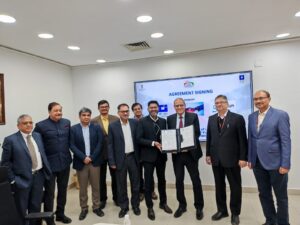
In a significant stride towards bolstering India’s indigenous telecommunications capabilities, the Centre for Development of Telematics (C-DOT), the premier R&D center of the Department of Telecommunications (DoT), has entered into an agreement with Silizium Circuits Pvt Ltd.This collaboration focuses on the “Design and Development of LEO Satellite Components and GNSS RF Front-End ASIC.
Silizium Circuits, a fabless semiconductor IP and SoC startup incubated under FABCI at IIT Hyderabad, brings its expertise in analog, RF, and mixed-signal technologies to this initiative.The project is supported by the Telecom Technology Development Fund (TTDF) scheme of the DoT, which aims to fund Indian startups, academia, and R&D institutions in designing and commercializing telecommunication products and solutions.
The agreement was formalized during a ceremony attended by key figures, including Dr. Rajkumar Upadhyay (CEO, C-DOT), Mr. Rijin John (Co-Founder & CEO, Silizium Circuits), Dr. Pankaj Kumar Dalela, Ms. Shikha Srivastava (Directors of C-DOT), and senior officials from DoT, such as Dr. Parag Agarwal (DDG, TTDF) and Shri. Vinod Kumar (DDG, SRI).
We’re thrilled to announce that Silizium Circuits has been selected as one of the few Indian semiconductor startups to participate in the India–Taiwan Semiconductor Exchange Program. This recognition marks a significant step forward in our global journey and reflects our commitment to innovation in the fabless semiconductor space. As part of this program, we had the opportunity to showcase our capabilities at SEMICON Taiwan 2024, one of the most influential semiconductor events in Asia. Supported by Taiwan’s National Science and Technology Council (NSTC) and hosted at Taiwan Tech Arena – South (TTA-South) in Tainan, we presented two working chips developed in collaboration with TSMC and outlined our roadmap for advanced analog and RF semiconductor design. The event also enabled us to engage with global industry leaders in areas such as automotive, health tech, AI/ML, navigation, 6G, and Industry 4.0. Our participation reflects not only the progress we’ve made but also the immense potential of cross-border collaboration in building world-class semiconductor solutions. We’re excited about the global relationships and technical opportunities that this program unlocks as we continue developing impactful technologies across GNSS, 5G, and satellite communications.
IIT Kanpur and Silizium Circuits Awarded ₹5 Crore Grant Under MeitY’s C2S Program
The Indian Institute of Technology (IIT) Kanpur, in collaboration with Silizium Circuits Private Limited, has been awarded a ₹5 crore Grant-in-Aid by the Ministry of Electronics and Information Technology (MeitY) under its Chips to Startup (C2S) program. The grant supports the development of a Radio Frequency (RF) Transceiver System on Chip (SoC) with an integrated RISC-V core, specifically designed for Sub-GHz applications.
The project aims to create an SoC that supports all prominent Sub-GHz standards, facilitating advancements in the Internet of Things (IoT) and indoor applications. The global market for such applications is projected to reach approximately $1.3 trillion by 2030.
Over a three-year period, IIT Kanpur will serve as the nodal agency, focusing on the development of significant mixed-signal IPs. Silizium Circuits will be responsible for designing the RF Front End and the complete System-on-Chip (SoC), as well as overseeing commercialization efforts.
Key investigators for this project include Prof. Imon Mondal, Prof. Chithra, and Prof. R.S. Ashwin Kumar from IIT Kanpur, along with Dr. Arun Ashok and Mr. Rijin John from Silizium Circuits. The project is further supported by ATWIC R&D, an organization dedicated to developing advanced electronic systems and subsystems.
This collaboration represents a significant step toward strengthening India’s position in complex SoC research and development, aligning with the nation’s broader goals of self-reliance in semiconductor technology.
We are deeply honoured to share that Silizium Circuits has been recognized as the “Most Promising Start Up” in the StartUp Winner – Semiconductor SoC, IP & Systems category at the IESA Annual Technovision 2022.
This recognition, presented by the India Electronics and Semiconductor Association (IESA), was awarded for our contributions to India’s electronics system design and manufacturing domain for the year 2021–22. It is both a humbling moment and a reminder of the responsibility we carry as an early-stage fabless startup working in the Analog, RF, and Mixed Signal IP space.
The award was presented during the 17th edition of IESA’s Vision Summit & India Embedded Electronics Show (VS-IEES), held on October 12 & 13, 2022 in Bengaluru. The theme of this edition — “Roadmap for Making India an Electronics & Semiconductor Nation in this Decade” — resonated deeply with our vision and long-term commitment.
We are grateful to the IESA jury, leadership, and especially Mr. Krishna Moorthy, for this meaningful encouragement. It inspires us to keep pushing forward — steadily, sincerely, and collaboratively — toward building indigenous semiconductor IPs that support India’s larger mission of technological self-reliance.
To our partners, mentors, colleagues, and supporters — thank you. This milestone belongs to all of you as much as it does to us.
We look forward to learning, growing, and contributing further to the semiconductor ecosystem in the years ahead.
Silizium Circuits is proud to announce the successful tape-out of its inaugural product, the SC2391 Front-End Module (FEM). This cutting-edge chip is engineered to provide multi-band functionality, supporting all Global Navigation Satellite Systems (GNSS) worldwide, including GPS, GLONASS, Galileo, BeiDou, and India’s NAVIC.
The SC2391 is also tailored for 5G applications, positioning it as a versatile solution in the rapidly evolving wireless communication landscape.Its design emphasizes low noise and high efficiency, catering to the stringent requirements of modern GNSS and 5G systems.
This achievement underscores Silizium Circuits’ commitment to advancing indigenous semiconductor solutions.
Stay tuned for upcoming updates on the testing and characterization results of the SC2391
 In a significant stride towards bolstering India’s indigenous telecommunications capabilities, the Centre for Development of Telematics (C-DOT), the premier R&D center of the Department of Telecommunications (DoT), has entered into an agreement with Silizium Circuits Pvt Ltd.